
How to Legally Reduce Your Tax in Cyprus in 2026

Home / Insights / How to Legally Reduce Your Tax in Cyprus in 2026
Tax Strategy · Cyprus 2026
How to Legally Reduce Your Tax in Cyprus in 2026:
The Structured Approach
Most investors know Cyprus has low tax. Few know how to access it legally — and even fewer enter with the right structure from the start.
"I want to pay less tax — legally." It is one of the most common reasons international investors and business owners begin looking at Cyprus.
The good news: the framework is real, well-established, and fully compliant with EU law. Cyprus offers some of the most competitive personal and corporate tax conditions in Europe — and the 2026 reform made several of them significantly more attractive.
The challenge: the benefits are not automatic. They depend entirely on how you enter, what you hold, and which residency status you establish — and in what sequence. Get the structure right and Cyprus delivers. Get it wrong and you pay the same rates you were trying to leave behind.
The Foundation
What actually makes Cyprus a low-tax jurisdiction
Cyprus is not a tax haven. It is a full EU member state with English common law, English-language courts and a transparent regulatory framework. What it offers is a deliberately competitive tax structure designed to attract international capital and business activity.
As of 1 January 2026, the key pillars are:
Personal Tax
0% on foreign dividends & interest
For qualifying Non-Dom residents, foreign-source dividends and interest are fully exempt from personal income tax — indefinitely.
Dividend Tax
5% — down from 17%
The Special Defence Contribution on dividends was cut from 17% to 5% from January 2026, dramatically improving profit extraction from Cyprus companies.
Capital Gains
0% on foreign assets
No capital gains tax on disposal of foreign shares, funds or overseas property for Cyprus tax residents. Applies regardless of Non-Dom status.
Corporate
15% — lowest effective in EU
Increased from 12.5% to meet OECD minimum, but simultaneous abolition of deemed distribution rules means the net burden for most structures is unchanged or lower.
The combination that matters: A Cyprus tax resident with Non-Dom status, holding foreign assets through a correctly structured Cyprus company, can legally achieve near-zero personal tax on investment income — within a full EU legal framework, with no secrecy and no offshore risk.
The Key Mechanism
Non-Domicile status: the most misunderstood tax tool in Cyprus
Non-Dom status is the foundation of Cyprus's personal tax advantage for international investors. It exempts qualifying individuals from the Special Defence Contribution — the tax that would otherwise apply to dividends, interest and rental income received from abroad.
Who qualifies: Any individual who has not been a Cyprus tax domicile for the 20 years prior to becoming a Cyprus tax resident. In practice, this covers almost all international investors relocating to Cyprus for the first time.
How long it lasts: 17 years from the date of establishing Cyprus tax residency. For most investors, this covers their entire planning horizon.
What Non-Dom status means in practical numbers
Without Non-Dom
Dividends from a Cyprus company: 5% SDC
Foreign dividends received personally: 5% SDC
Interest income: 17% SDC (unchanged)
Foreign rental income: 3% SDC
With Non-Dom Status
Dividends from a Cyprus company: 0%
Foreign dividends received personally: 0%
Interest income: 0%
Foreign rental income: 0%
Important: Non-Dom status does not eliminate all taxes. Cyprus income tax still applies to employment income and trading profits above the annual threshold. The exemption is specifically for passive investment income — dividends, interest and rents — which is where most international investors hold the bulk of their returns.
The Most Expensive Mistake
Why people pay full tax in Cyprus even when they don't have to
Every year, international investors establish residency in Cyprus, buy property, and continue paying taxes at near the same effective rate they had before. Not because the framework failed them — but because they entered in the wrong sequence.
The three structural errors that account for most of these cases:
Mistake 01
Buying property before establishing the holding structure
Property purchased in personal name creates a direct asset sitting outside any holding framework. Rental income is taxed personally. On disposal, any gain on Cyprus-located property is subject to capital gains tax at 20%. Restructuring post-purchase is significantly more expensive — in professional fees, transfer taxes and lost time — than structuring correctly before acquisition.
Mistake 02
Choosing the residency route without tax planning
Cyprus has four main residency pathways — Pink Slip, Digital Nomad Visa, Permanent Residency by Investment and PR by Income. Each interacts differently with your existing tax residency, your income sources and the timeline for establishing Non-Dom status. Choosing based on speed or cost rather than fiscal fit creates gaps that cannot easily be corrected retroactively.
Mistake 03
Treating tax residency and legal residency as the same thing
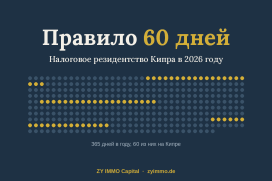
You can hold a Cyprus residency permit and still be a tax resident of another country — which means Cyprus's tax benefits do not apply to you at all. Establishing Cyprus tax residency requires meeting specific conditions: 60-day rule, no tax residency elsewhere, or 183-day physical presence. Failing to establish this correctly means you carry a residency card with no fiscal effect.
The common thread: All three mistakes are the result of entering Cyprus as a transaction — buying a property, processing a visa — rather than as a structured strategy. The framework rewards planning. It does not automatically reward presence.
The Correct Sequence
How to enter Cyprus correctly — step by step
The sequence matters as much as the structure. This is the approach that consistently produces the intended tax outcome for international investors entering Cyprus.
01
Map your current position
Identify your existing tax residency, the nature of your income and assets, and your obligations in your current jurisdiction before making any moves.
02
Define the holding structure
Determine how assets will be held — Cyprus company, personal name, trust or hybrid — based on your income type, exit horizon and beneficiary structure.
03
Select the residency route
Choose the residency pathway that fits your tax position, physical presence capacity and Non-Dom timeline — not the one that is fastest or cheapest.
04
Establish tax residency correctly
Formally cease tax residency in your previous jurisdiction. Register as a Cyprus tax resident through the correct procedure. Document the Non-Dom claim from the first year.
Only at this point — once the structure is in place and tax residency is formally established — does it make sense to move capital, acquire assets or begin extracting income through the Cyprus framework.
2026 Update
What the January 2026 reform changed — and what it didn't
The 2026 Cyprus Tax Reform introduced the most significant changes to the island's fiscal framework in a decade. For international investors, the net effect is positive — but requires understanding what actually changed.
| Item | Before 2026 | From Jan 2026 | Impact |
|---|---|---|---|
| Dividend tax (SDC) | 17% | 5% | Strongly positive |
| Deemed distribution rules | Applied after 2 years | Abolished | Strongly positive |
| Corporate tax rate | 12.5% | 15% | Neutral for most structures |
| Non-Dom exemptions | Intact | Intact | No change — positive |
| Capital gains on foreign assets | 0% | 0% | No change — positive |
| Residency from investment | €300,000 | €300,000 | No change |
Bottom line: The 2026 reform is net positive for properly structured international investors. The 12-percentage-point reduction in dividend taxation and the abolition of deemed distribution rules together outweigh the 2.5-point increase in corporate rate for most holding and investment structures. Investors who entered correctly before 2026 benefit immediately. Those who enter now do so into an improved framework.
Next Step
The framework is available. The question is whether your structure accesses it.
ZY IMMO Capital works with a limited number of private investors each year to coordinate exactly this: a structured assessment of your current position, the definition of the optimal Cyprus entry route, and coordinated execution through licensed legal and tax professionals.
We do not provide legal or tax advice directly. Our role is strategy and coordination — ensuring the right professionals are working to the right brief, in the right sequence, from the first conversation.
Request a Private Strategy Assessment
Minimum capital allocation: €300,000 · Confidential · No obligation
Include: your current tax residency · nature of income/assets · objective
Subject: [STRATEGY] Cyprus Tax Assessment Request
We respond to qualified enquiries within one business day. All communications are strictly confidential.
“Cyprus does not reduce your tax automatically. A correctly structured entry does.”
Disclaimer: This article is for informational purposes only and does not constitute legal, tax or financial advice. Tax laws change frequently and individual circumstances vary. Always obtain qualified professional advice before making any fiscal or investment decisions. ZY IMMO Capital Ltd is not a licensed real estate agency, law firm or tax advisory practice under Cyprus Law 71(I)/2010.
Read full disclaimer · © 2026 ZY IMMO Capital Ltd · HE 475591 · Limassol, Cyprus



There are no comments yet
Leave a Comment