
Cyprus vs. The Rest: Why Founders Are Choosing Cyprus in 2026

Every week I speak with founders who have already "looked at" Spain, Monaco, UAE, Portugal, or Malta.
Most of them come back to Cyprus.
Here is why — in facts, not promises.
| Cyprus | Spain | Monaco | UAE | Portugal | Malta | |
|---|---|---|---|---|---|---|
| Corporate tax | 15% | 25% | None | 9% | 21% | 35% (~5% via refund) |
| Dividends (personal) | 0% Non-Dom | 19–28% | 0% | 0% | 28% | 0% Non-Dom |
| Capital gains on shares | 0% | 19–28% | 0% | 0% | 28% | 0% Non-Dom |
| Residency requirement | 60 days | 183 days | 183 days + property | 183 days | 183 days | 183 days |
| EU membership | ✅ | ✅ | ❌ | ❌ | ✅ | ✅ |
| Common Law | ✅ | ❌ | ❌ | ✅ (DIFC) | ❌ | ✅ |
| English language | ✅ | ❌ | ❌ | ✅ | ❌ | ✅ |
| Substance requirements | Flexible | Strict | N/A | Tightening | Strict | Tightening |
| Regime stability | High | Medium | High | Medium | Low | Medium |
Spain — Beckham Law works for employees, not most founders.
Directors who own more than 25% of the business cannot qualify for the Beckham Law unless they qualify under a startup or entrepreneur scheme. If you fully own your business — Spain's special regime is not available to you. And without it, Spain's standard IRPF rates can reach 47% for high earners. Corporate tax sits at 25%. Add Hacienda's aggressive substance scrutiny and 183-day residency requirement — and Spain is a painful destination for founders who own their business outright.
Monaco — lifestyle, not structure.
Zero personal tax — yes. But no corporate framework, no EU membership, no treaty network worth speaking of. Property requirements are extreme. Monaco is a residency address, not a business jurisdiction. If your company needs a defensible EU structure — Monaco gives you nothing.
UAE — the zero-tax narrative is over.
Corporate tax in UAE has been in effect since June 2023, with a 9% rate on taxable income above AED 375,000. Free zone companies are not automatically exempt — they must meet five strict conditions including adequate UAE substance, qualifying income, and arm's length pricing. And the fundamental problem remains: UAE is not EU. For founders serving European markets, UAE banking and credibility create increasing friction.
Portugal — NHR is gone, IFICI is narrow.
Portugal's Non-Habitual Resident regime was abolished for new applicants from January 2024, replaced by the substantially narrower IFICI programme. IFICI focuses on researchers and innovators in science, technology, healthcare, and green energy. If you are a founder, investor, or passive capital holder — IFICI is not for you. The window has closed.
Malta — similar on paper, riskier in practice.
Malta's nominal corporate tax rate is 35%, but non-resident shareholders can claim a 6/7ths refund, bringing the effective rate to approximately 5%. Attractive — but the refund takes months. More critically, Malta companies must have genuine substance: directors who actually meet in Malta, key decisions taken in Malta, operations meaningfully conducted from Malta. EU anti-avoidance directives mean empty shell companies face increasing scrutiny.
- 60-day residency rule — the only EU jurisdiction where you can become tax resident in 60 days, not 183. For internationally mobile founders, this is the single most important differentiator.
- 0% on dividends, interest, capital gains — for Non-Dom residents. Not time-limited. Not under political review. Available for up to 17 years.
- 15% corporate tax — among the lowest in the EU. The 15% global minimum applies only to multinationals with €750M+ group revenue.
- EU + Common Law + English — the only EU jurisdiction that combines all three. Contracts, courts, banking — all in English, all within EU framework.
- Substance is achievable — a director on the ground, an office, a bank account. Cyprus allows genuine operational presence without a 50-person headcount.
- 65+ tax treaties — your structure is defensible in your home jurisdiction.
- Stability — Cyprus has maintained its core tax framework for over a decade. No sudden abolitions, no political reversals.
It's which sequence.
Cyprus doesn't work if you arrive, open a company, and assume the benefits follow automatically. It works when the structure is built before residency begins — corporate entity, substance, banking, personal tax positioning — in the correct order."
Start with the assessment.
If you are considering corporate relocation in 2026 — download our Corporate Relocation Questionnaire, complete it, and return it to us. We will review your situation and come back to you within 48 hours.
↓ Download Corporate Questionnaire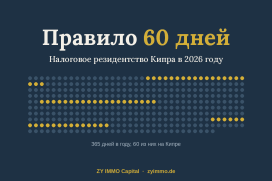



There are no comments yet
Leave a Comment